THE BREAKER github.com/tarang-tj/the-breaker ↗
DESIGN COMPLETE · BUILD IN PROGRESS

A hardware kill-switch
for my AI agents.

The default state is stop.

I run a small fleet of AI agents that handle research, monitoring, and busywork while I sleep. Software has an off switch only as long as the software cooperates. So I gave them one that doesn't.
The problem

Yelling at the screen does nothing.

The agents run unattended. If one misbehaves, there is no physical way to make it stop — the "off switch" only works while the software chooses to listen. I wanted a control I could reason about physically: something I can see, flip, and trust.

How it works

Switch → Pi → token → agents.

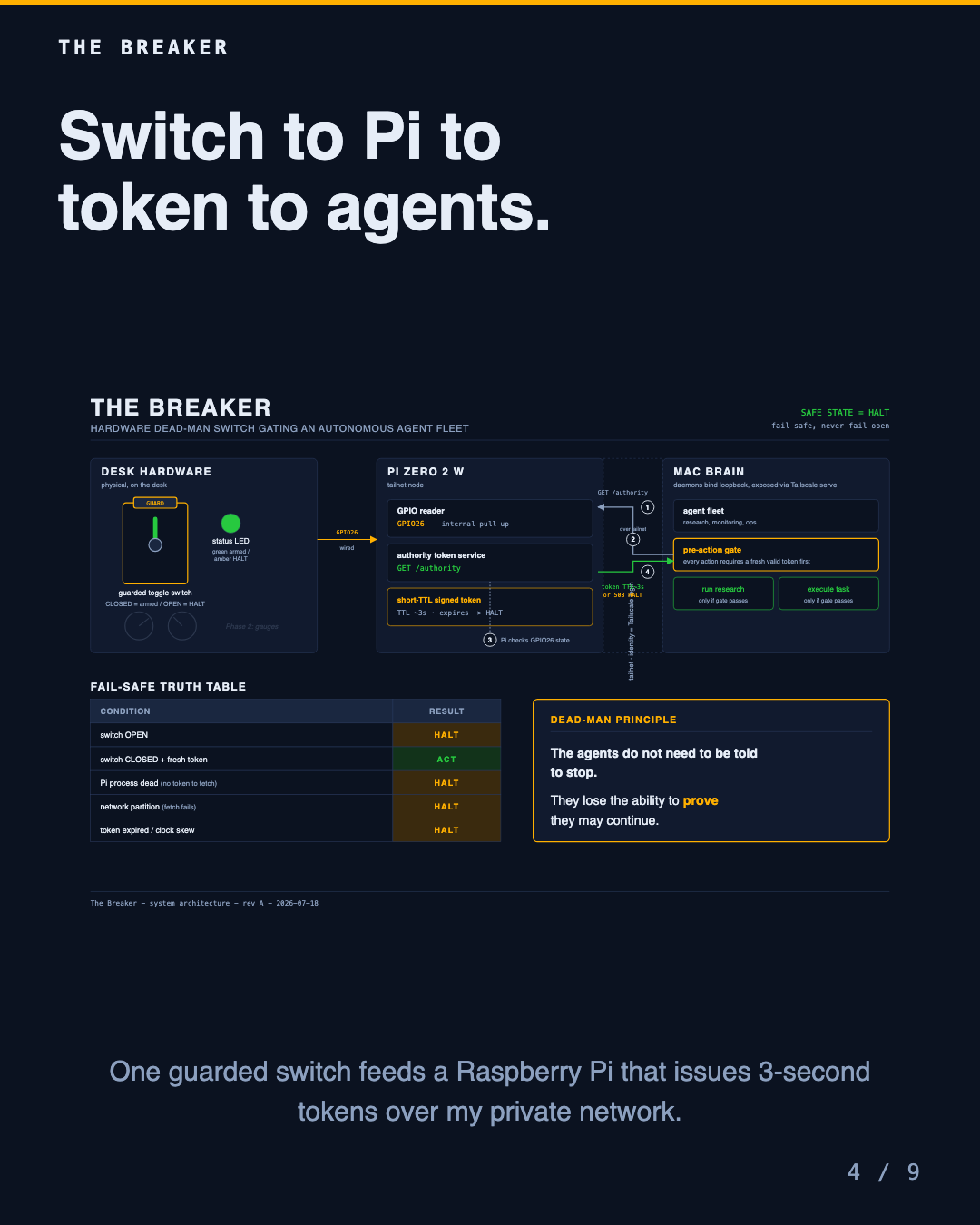
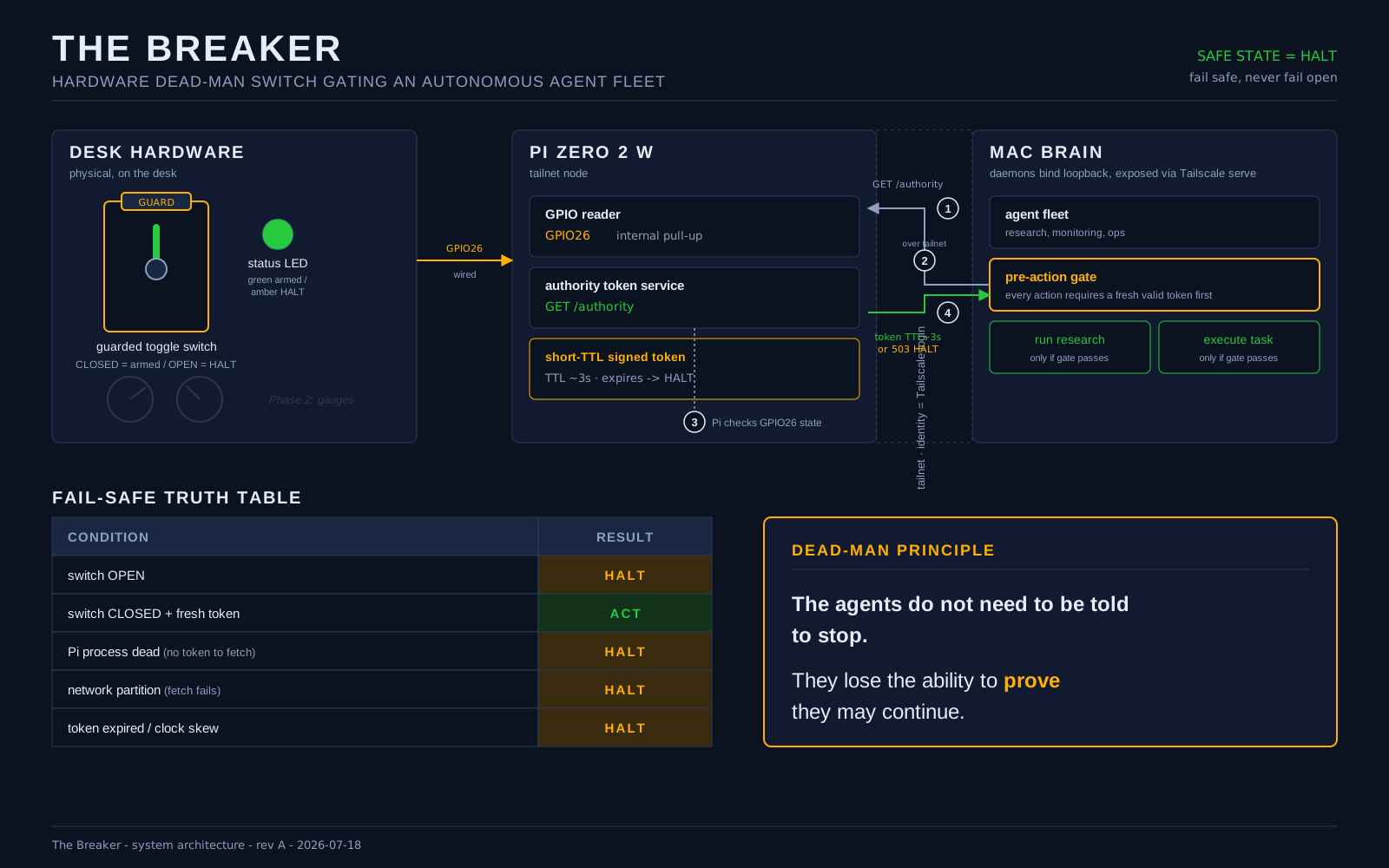
A guarded toggle feeds a Raspberry Pi Zero 2 W on my private Tailscale network. The Pi serves a short-TTL authority token over HTTP. Every agent must hold a fresh token before every action. The agents are never told to stop — they lose the ability to prove they may continue.

System architecture: guarded switch to Raspberry Pi to short-TTL token to Mac agent fleet, safe state HALT
One guarded switch feeds a Pi that issues 3-second tokens over a private network.
Fail-safe logic

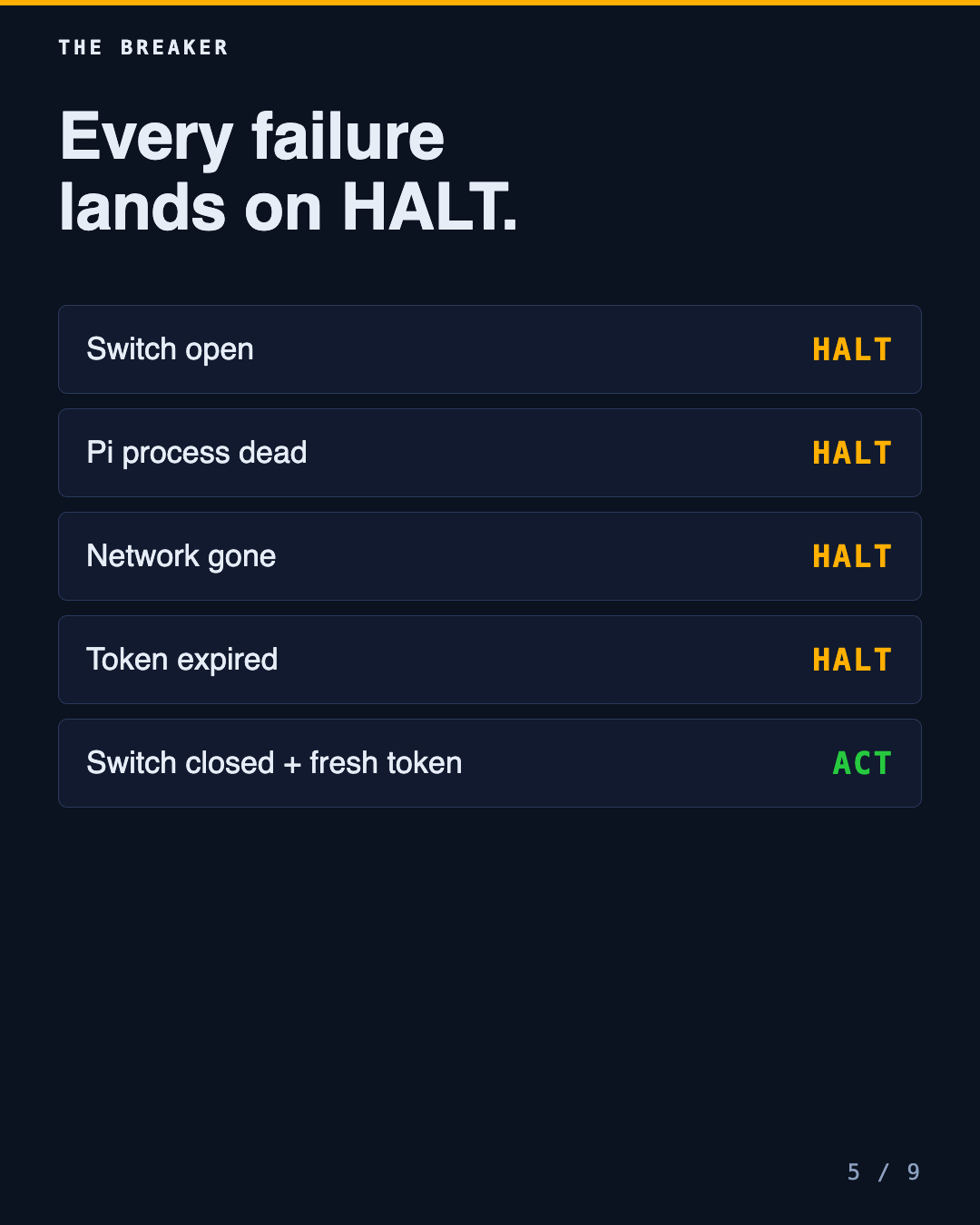
Every failure lands on HALT.

The safe state is reached by loss, not by a command. Anything that breaks the chain — the switch, the Pi, the network, the clock — fails safe.

Switch OPENHALT
Pi process dead (no token to fetch)HALT
Network partition (fetch fails)HALT
Token expired / clock skewHALT
Switch CLOSED + fresh tokenACT
Wiring

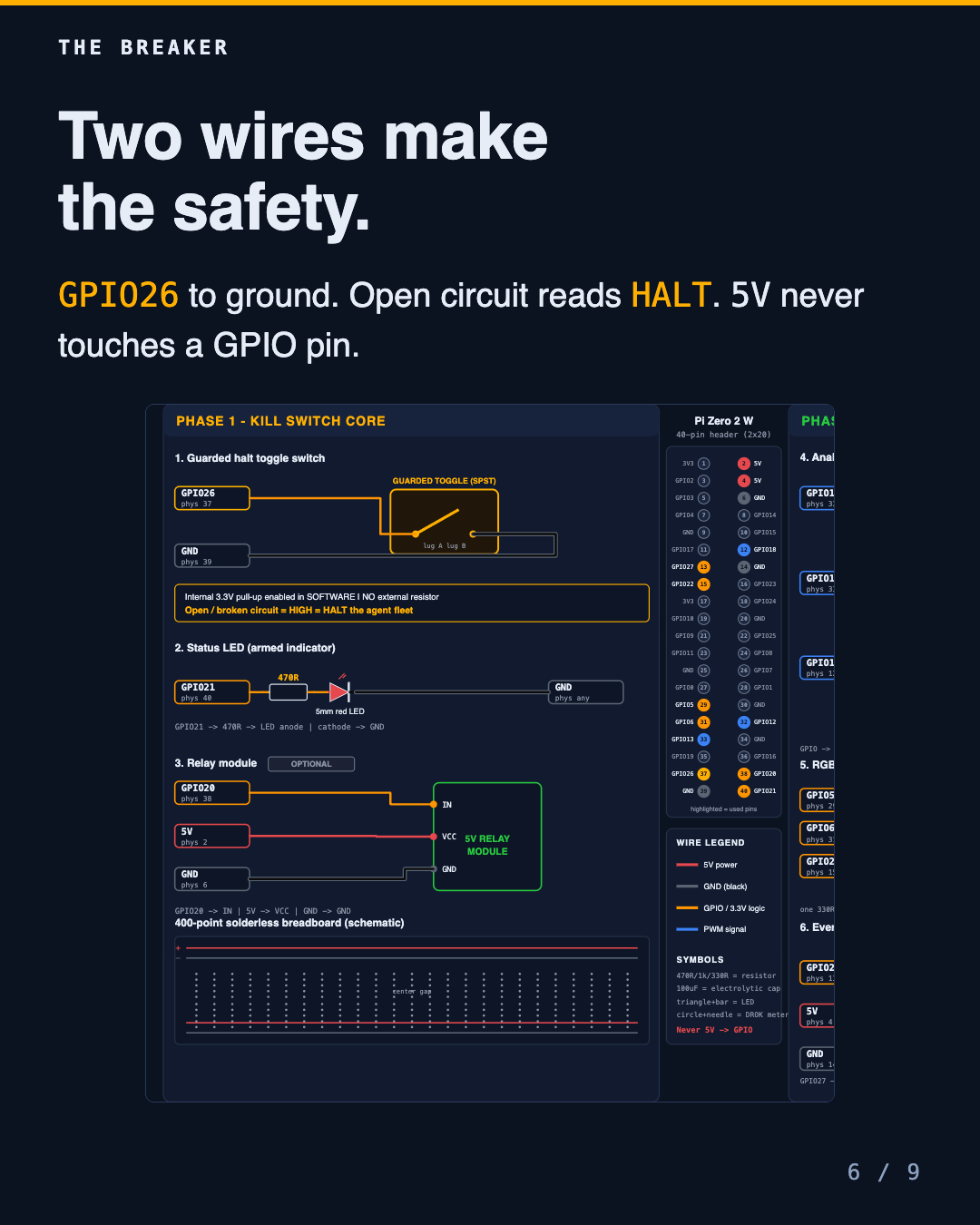
Two wires make the safety.

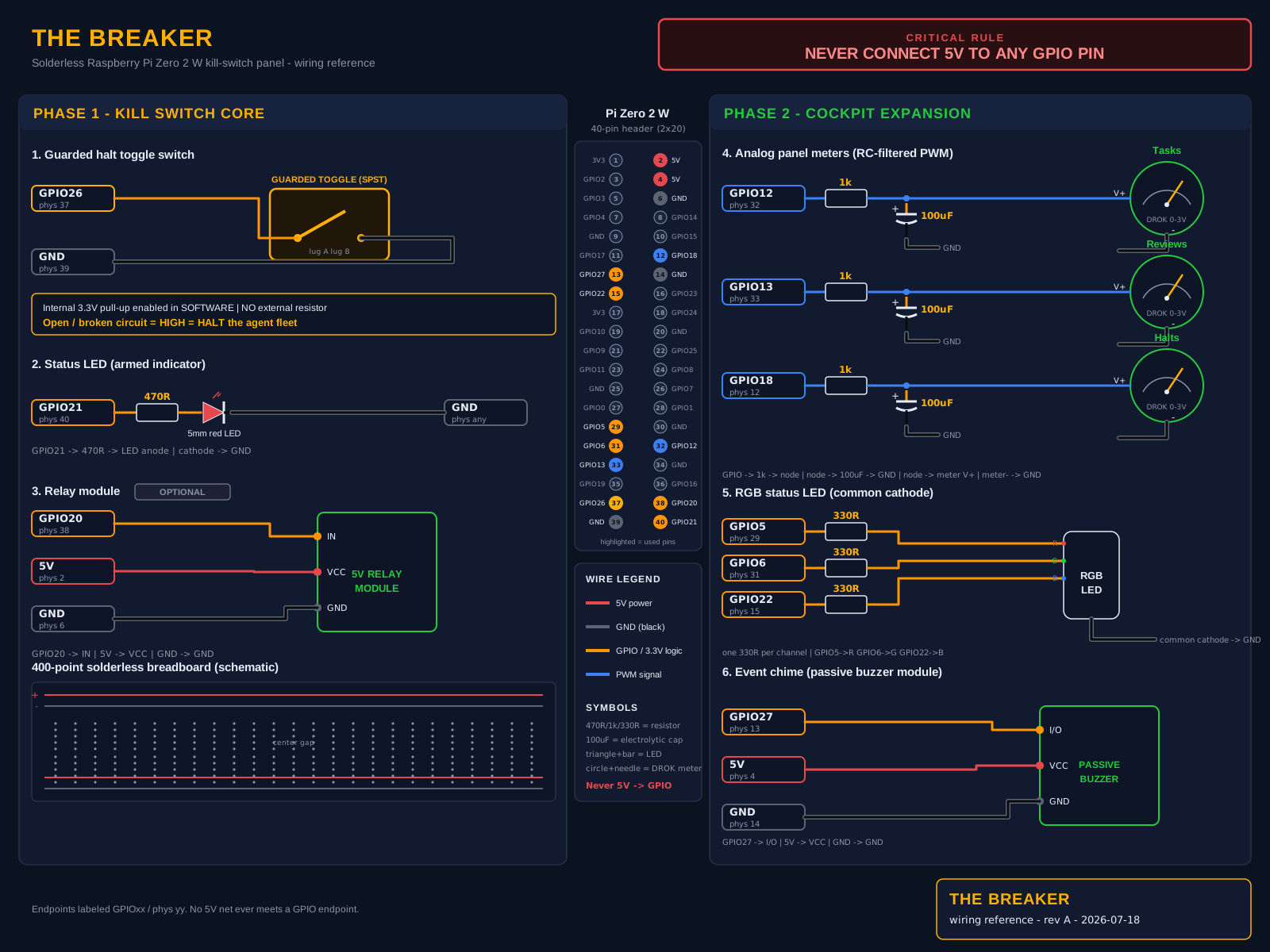
GPIO26 to ground, with the Pi's internal pull-up in software. An open or broken circuit reads HIGH = HALT. 5V never touches a GPIO pin.

Wiring diagram for the halt switch, status LED, and relay
Solderless bench wiring. Full pin map in hardware/gpio-map.md.
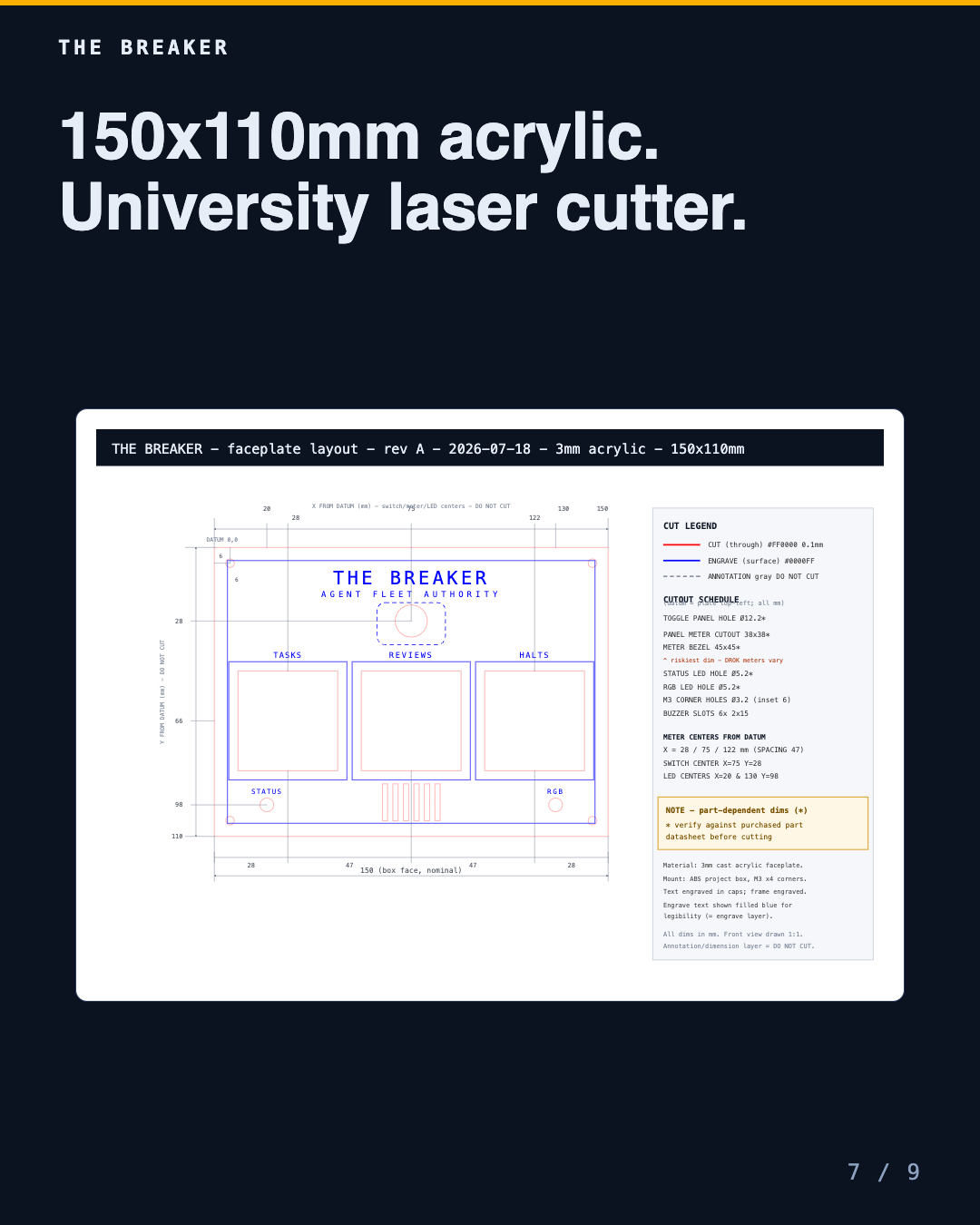
Faceplate

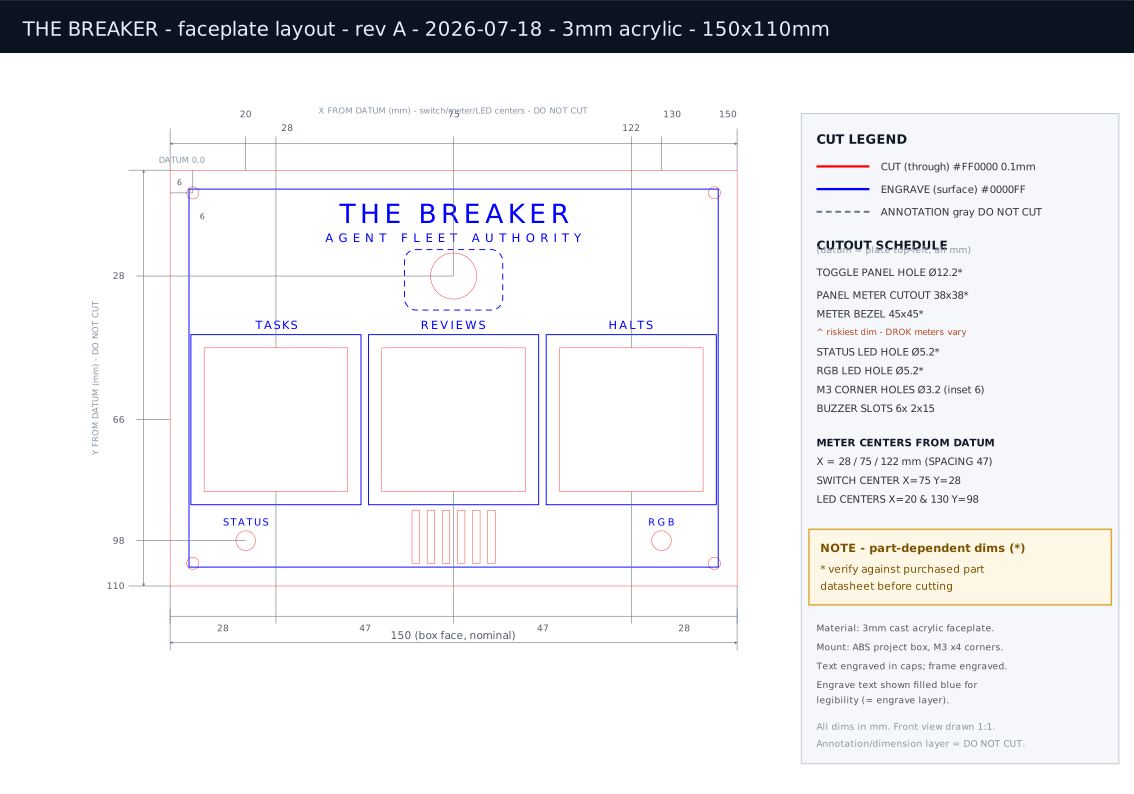
150×110mm laser-cut acrylic.

Cut at the UW Bothell makerspace. Phase 2 adds three analog gauges for live agent-activity metrics (tasks, reviews, halts), an RGB status LED, and an event chime.

Faceplate layout with guarded toggle, status LED, and three gauge cutouts
Bill of materials

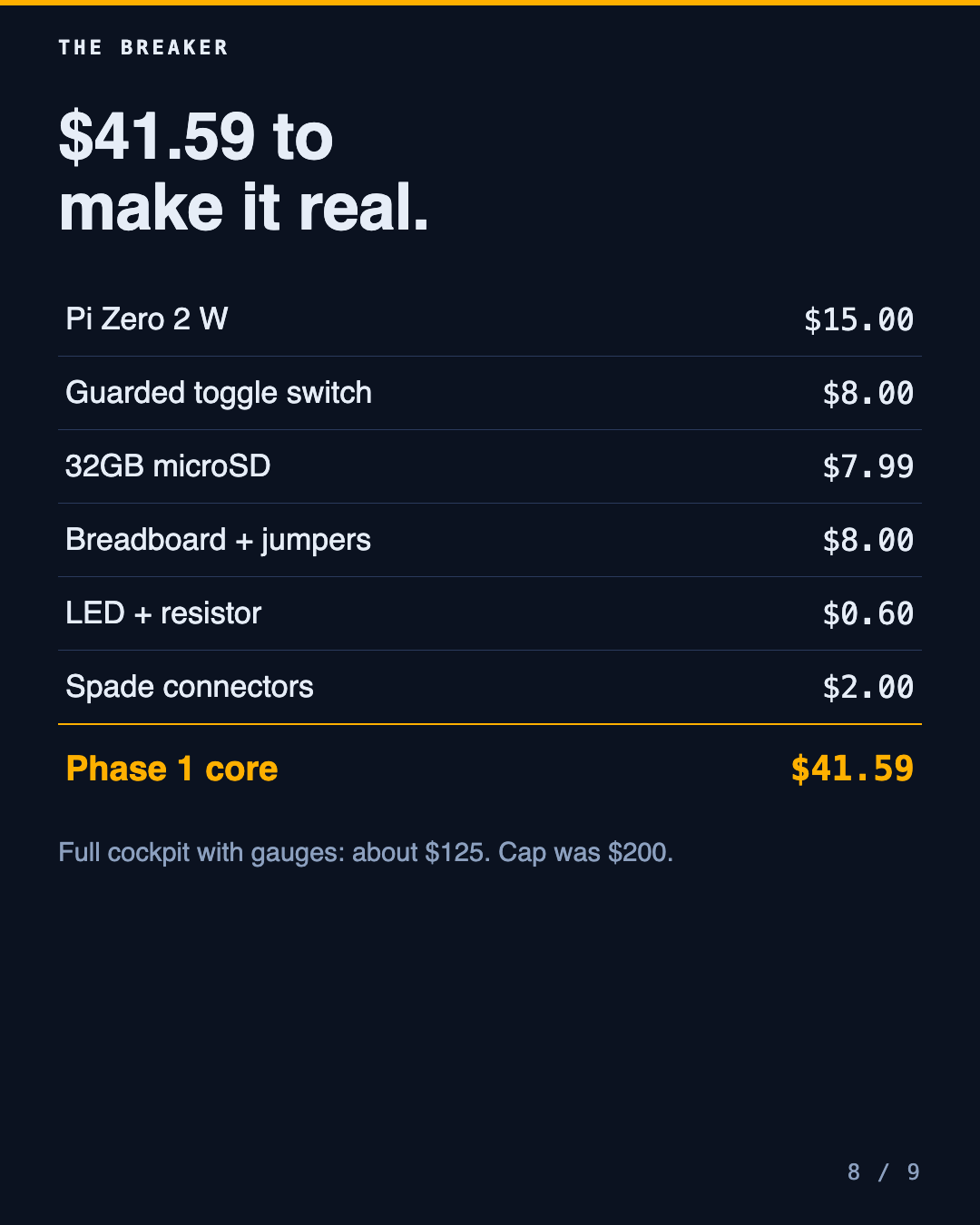
$41.59 to make it real.

Phase 1 gets a working bench demo. Both phases land around $106–125, under a $200 cap. The full itemized list, hand-audited, is in hardware/bom.md.

Raspberry Pi Zero 2 W (pre-soldered headers)$15.00
Guarded missile toggle switch$8.00
SanDisk Ultra 32GB microSD$7.99
400-point solderless breadboard$3.00
Female-female Dupont jumpers (40-pack)$5.00
5mm red LED + 470Ω resistor$0.60
Pre-crimped female spade connectors (×4)$2.00
Phase 1 core$41.59
Design deck

The full nine-slide reveal.